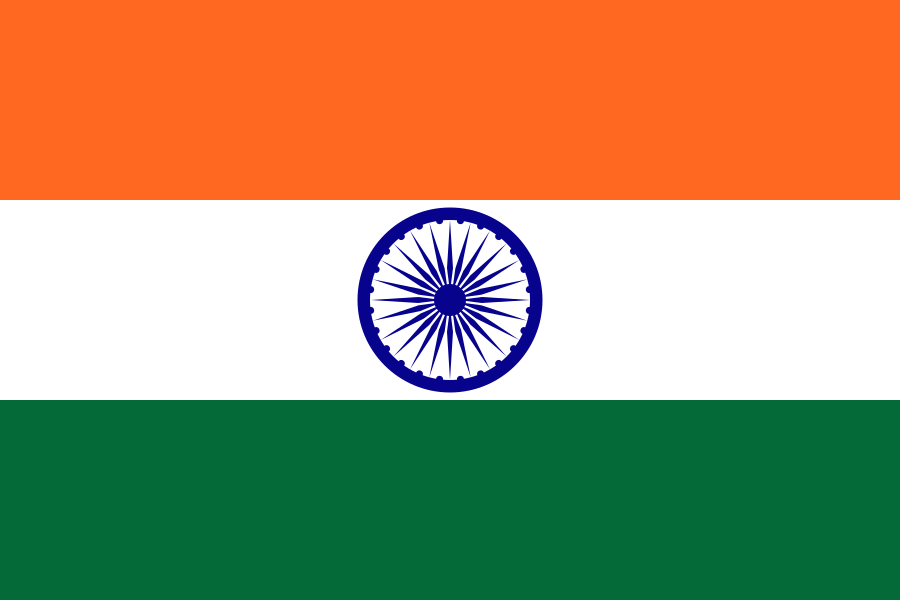
 Curriculum comparison
IB vs Indian curriculum
The International Baccalaureate and India's CBSE curriculum represent two contrasting approaches to secondary education: one designed for internationally mobile students seeking a globally recognized, inquiry-based credential, the other built to serve the worl...
Indian
Fees depend on the school and city, not the curriculum alone. Ask schools for their current indicative annual tuition.
Schools teaching each curriculum
A sample of schools we list. Fees are indicative annual tuition.
IB
135 schools- ACS Doha International School Doha · West Bay
- American Community School Abu Dhabi Abu Dhabi · Al Mushrif
- American School of Paris Paris · Saint-Cloud
- Amsterdam International Community School (AICS) Amsterdam · Buitenveldert
- Bangkok Patana School Bangkok · Bangna
- BBIS Berlin Brandenburg International School Berlin · Kleinmachnow
Indian
13 schools
- Delhi Private School, Sharjah Sharjah · Muwaileh
- DPS Modern Indian School Doha · Al Sadd
- GEMS Millennium School - Sharjah Sharjah · Muwaileh
- GEMS Modern Academy Dubai · Nad Al Sheba
- GEMS Our Own English High School - Sharjah (Girls) Sharjah · Industrial Area 6
- Global Indian International School (GIIS) SMART Campus Singapore
Free for parents
Considering IB or Indian schools?
Choose your city, then tick the schools you'd like fees and admissions details from. One form reaches all of them.
Educational philosophy
IB
- The IB philosophy is grounded in internationalism, inquiry, and the development of the "whole person" as an intellectually curious, principled, and culturally aware global citizen.
- The IB Learner Profile — which describes attributes including being inquirers, knowledgeable, thinkers, communicators, principled, open-minded, caring, risk-takers, balanced, and reflective — functions as a philosophical backbone across all four programs, from the Primary Years Programme (PYP) through the Diploma Programme (DP).
- Rather than transmitting a fixed national canon, the IB emphasizes the process of learning: how students ask questions, gather and evaluate evidence, construct arguments, and reflect on their own thinking and learning.
The Theory of Knowledge (TOK) course in the Diploma Programme, taken by all students in their final two years, is a distinctive embodiment of this approach — it asks students to examine the nature of knowledge itself across disciplines, exploring how we know what we claim to know in mathematics, the natural sciences, the arts, history, and ethics. This metacognitive orientation, combined with the Extended Essay (a 4,000-word independent research paper) and the CAS (Creativity, Activity, Service) program, produces graduates who are not only academically prepared but practiced in self-direction and independent intellectual inquiry.
Indian
- The CBSE curriculum philosophy is shaped by India's post-independence national priorities: creating a technically capable, socially equitable workforce through a standardized, accessible, and academically rigorous public education system.
- The curriculum is designed to provide every student — from urban private schools to rural government institutions — with a consistent foundation in core academic disciplines, ensuring that national mobility and equal access to higher education are not constrained by geography or school type.
- In practice, this means a curriculum that is content-heavy, teacher-directed, and examination-aligned, with clear syllabi, official NCERT textbooks, and centrally designed assessment frameworks.
The NEP 2020 reform agenda is gradually shifting this model: introducing more experiential learning, reducing rote content, and encouraging competency-based questions that test understanding and application rather than recall. Yet the fundamental orientation remains utilitarian — education as preparation for productive participation in Indian society and the global economy — with particular emphasis on STEM pathways leading to engineering, medicine, and technology professions that have defined middle-class aspiration in India for decades.
Assessment and examinations
IB
- IB Diploma Programme assessment is multidimensional and externally moderated, combining internal assessments (IAs) — completed during the two-year program and marked by teachers, then moderated by IBO examiners — with formal terminal examinations at the end of Year 2.
- Each of the six subject groups uses a combination of these methods, with IA weightings typically ranging from 20% to 30%.
- The 45-point scale comprises 42 points from six subjects (each marked 1–7) plus up to 3 bonus points from TOK and the Extended Essay, which are assessed together via a matrix.
A score of 24 points with a pass in TOK/EE and no failing grades constitutes the minimum passing threshold. The Extended Essay — a 4,000-word independent research paper supervised by a school mentor — is a significant undertaking that develops research, argumentation, and academic writing skills directly transferable to undergraduate study. Examinations themselves are known for requiring application and synthesis rather than recall, with marking schemes and specimen papers publicly available for transparent preparation.
Indian
- CBSE assessment is built around high-stakes national board examinations at Class 10 (Secondary School Certificate) and Class 12 (Senior School Certificate), centrally administered by the CBSE and marked by trained examiners using published marking schemes.
- Internal assessment components — including practical examinations, projects, and periodic tests — typically contribute 20–30% of the final grade, with the board examination determining the majority.
- The CBSE has progressively introduced competency-based questions (CBQs) since the 2021–22 academic year, incorporating case studies, application problems, and analytical questions alongside traditional descriptive and short-answer formats.
For Class 12 students in the sciences, the board examination is closely aligned — both in content and preparation strategy — with national entrance tests such as JEE (Main and Advanced) for engineering and NEET for medicine, creating a dual-preparation dynamic that shapes how schools and students allocate their study time throughout the academic year.
University recognition
The IB Diploma is among the most universally recognized pre-university qualifications in the world, with formal acceptance agreements at thousands of universities across the UK, USA, Canada, Europe, Australia, and Asia. Many top-ranked universities actively seek IB Diploma graduates for their research experience, interdisciplinary preparation, and demonstrated capacity for independent intellectual work. Predicted and final IB scores serve as the primary metric in international admissions, with competitive university offers often requiring 38–42 points for the most selective programs. CBSE Class 12 graduates applying within India use CUET for central university admissions, and competitive engineering and medical aspirants sit JEE and NEET respectively. Internationally, CBSE transcripts are accepted at many universities worldwide, but applicants typically need to supplement with SAT/ACT or IELTS/TOEFL scores, and individual university grade conversion policies mean that a 90%+ CBSE score may be evaluated differently across institutions, requiring careful research during the application process.
Key features
IB curriculum
- Internationally recognized across 150+ countries
- Inquiry-based, student-centered learning approach
- Interdisciplinary connections and holistic assessment
- Extended Essay develops independent research skills
- CAS (Creativity, Activity, Service) component builds character
- Theory of Knowledge (TOK) encourages critical and reflective thinking
Indian curriculum
- Strong foundation in mathematics, science, and technology
- Affordable education option with high academic standards
- CBSE board examinations — recognized by universities worldwide
- NEP 2020 reforms introducing flexibility and competency-based learning
- Extensive network of affiliated schools globally
- Emphasis on competitive exam preparation and analytical thinking
Strengths and trade-offs
IB
Strengths
- Globally recognized credential accepted at more than 5,700 schools in about 160 countries with formal university agreements
- TOK, Extended Essay, and CAS develop research skills, metacognition, and community engagement
- Inquiry-based learning builds critical thinking and self-direction valued by selective universities worldwide
- Flexible subject choices across six groups allow genuine academic breadth alongside specialization
- Strong preparation for the independent learning demands of undergraduate academic life
Trade-offs
- Significantly higher tuition costs than CBSE; IB school fees internationally often range from USD 15,000–40,000 per year
- Very high academic workload in the IBDP can lead to stress and burnout, especially for students managing 6 subjects plus TOK/EE/CAS simultaneously
- Not directly aligned with Indian competitive entrance examinations (JEE/NEET), requiring additional preparation
- Quality and support vary across IB World Schools; not all schools implement the program equally effectively
Indian
Strengths
- Vast network of 27,000+ schools ensures widespread availability and accessibility at significantly lower cost
- Curriculum is directly aligned with JEE and NEET preparation for competitive engineering and medical pathways
- NEP 2020 reforms are progressively improving competency orientation and curricular flexibility
- Highly cost-effective compared to IB, making it accessible across a wide range of socioeconomic backgrounds
- Strong brand recognition across South Asia, the Middle East, and Southeast Asia diaspora communities
Trade-offs
- Strong historical emphasis on rote memorization and examination performance over conceptual understanding
- Limited exposure to interdisciplinary inquiry, research skills, and global citizenship perspectives
- Class 12 examination pressure is extremely high and closely tied to career trajectory, creating stress
- International portability requires supplementing the CBSE transcript with additional standardized tests
Which suits your child?
Choose IB if…
- The IB is the right choice for students who are internationally mobile, who aspire to study at universities outside India, or who are drawn to a rigorous, intellectually expansive curriculum that values inquiry as much as content mastery.
- It is particularly well-suited to students who enjoy research, debate, and interdisciplinary thinking — those who will thrive on the challenge of writing a 4,000-word Extended Essay and engaging seriously with Theory of Knowledge.
- Families who can absorb the higher tuition cost and who want a single credential recognized worldwide without the need for supplementary standardized testing will find the IBDP a compelling investment.
Choose Indian if…
- The CBSE is the right choice for families primarily rooted in India or within Indian diaspora communities who anticipate their child attending Indian universities or competitive national programs in engineering and medicine.
- It is also the practical choice for families who need the broad availability and cost-effectiveness of a large national network.
- Students who are strongly motivated by STEM careers and who are prepared to engage with the intensive preparation culture around JEE and NEET will find the CBSE curriculum directly aligned with those ambitions.
With NEP 2020 continuing to improve the curriculum's quality and flexibility, the CBSE is evolving toward a more balanced profile while retaining its core strength in structured academic excellence.
Questions parents ask
IB Diploma graduates can apply to Indian universities, but they must still sit the relevant national entrance examinations: JEE Main/Advanced for IITs and NITs, and NEET for medical colleges including AIIMS. The IB curriculum is not specifically aligned with JEE or NEET syllabi, so students intending to apply to these programs typically require dedicated additional preparation beyond the IBDP coursework.
Most educators and students who have experienced both describe the IB Diploma as more demanding overall — not necessarily because individual subjects are harder, but because the combination of six subjects, Theory of Knowledge, Extended Essay, and CAS simultaneously over two years creates a very high total workload. CBSE Class 12 is also demanding, particularly for students preparing simultaneously for JEE or NEET, but the workload structure is different: more focused and subject-specific.
There is no direct official conversion formula between IB scores and CBSE percentages. However, as a rough guide, many universities treat an IB score of 38/45 as broadly equivalent to a CBSE result of approximately 90–92%. A score of 42/45 is typically considered equivalent to 95%+ in CBSE. Specific conversion tables vary by institution, and students should check individual university policies.
The cost difference is substantial. In major international cities, IB World Schools typically charge between USD 15,000 and USD 40,000 per year, depending on location and school prestige. CBSE schools in the same cities typically range from USD 3,000 to USD 12,000 per year. This makes CBSE significantly more accessible for Indian diaspora families, while IB is positioned as a premium international option.
Yes, though with caveats. Many international universities accept CBSE Class 12 results for admission, but students typically need to supplement their application with standardized test scores (SAT/ACT for the US, IELTS/TOEFL for English proficiency) and sometimes subject-specific tests. Strong CBSE results (90%+) combined with competitive SAT/ACT scores make Indian students competitive applicants to universities in the UK, Canada, USA, and Australia.